Date: 1 Dec 2025
Oasis Circular No.: 2509
Subject: Vessel Routing System for Central Bohai Bay Waters to Enter into Force on 1 January 2026
The central waters of Bohai Bay serve as a critical gateway for vessels accessing the major ports of Tianjin, Huanghua, and Caofeidian, characterized by complex and intersecting traffic flows. In response to the escalating vessel traffic density, the China MSA promulgated the "Vessel Routing System for the Central Waters of Bohai Bay" on November 25, 2025. The new system is scheduled to take effect on January 1, 2026, for a period of five years.
Scope of the Routing System
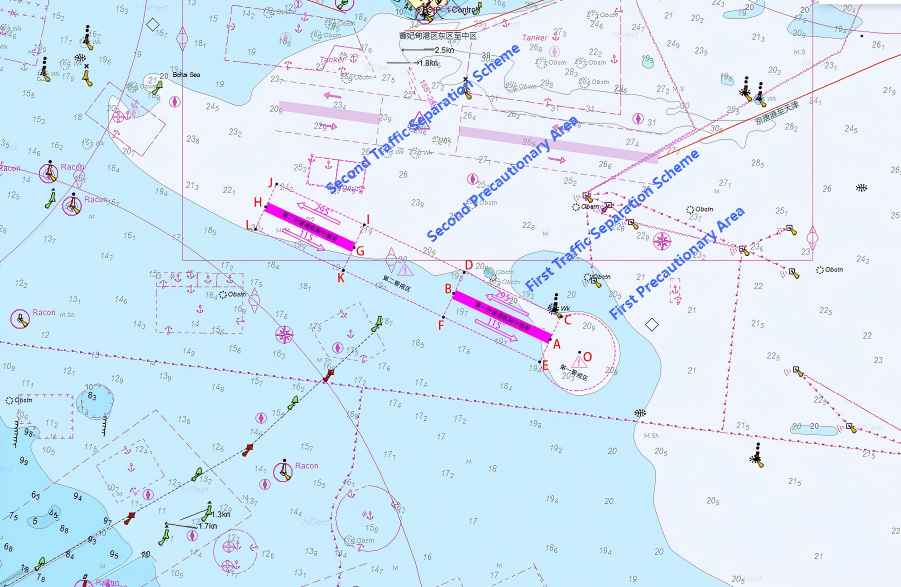
The routing system consists of the First Traffic Separation Scheme, the First Precautionary Area, the Second Traffic Separation Scheme, and the Second Precautionary Area.
I.First Traffic Separation Scheme
The First Traffic Separation Scheme consists of a separation zone and traffic lanes.
Separation Zone: A zone bounded by a line connecting the following geographical positions, 5.3 nautical miles in length and 0.5 nautical miles in width, centred on the following line:
A: 38°39'02.102"N / 118°38'19.806"E
B: 38°41'16.693"N / 118°32'11.751"E
Traffic Lanes:
(1) The northern boundary of the traffic lanes is a line connecting the following geographical positions:
C: 38°40'10.498"N / 118°39'00.476"E
D: 38°42'25.074"N / 118°32'52.494"E
(2) The southern boundary of the traffic lanes is a line connecting the following geographical positions:
E: 38°37'53.688"N / 118°37'39.136"E
F: 38°40'08.356"N / 118°31'31.099"E
(3) Westbound Traffic Lane: The area between the separation zone and the northern boundary of the traffic separation scheme. It is 5.3 nautical miles long and 1 nautical mile wide. The recommended direction of traffic flow is 295°(true bearing).
(4) Eastbound Traffic Lane: The area between the separation zone and the southern boundary of the traffic separation scheme. It is 5.3 nautical miles long and 1 nautical mile wide. The recommended direction of traffic flow is 115°(true bearing).
II.First Precautionary Area
The First Precautionary Area is the waters bounded by the arc of a circle with a radius of 1.925 nautical miles, centered on point O (38°38'25.091"N / 118°40'00.974"E), and the lines sequentially connecting the following points:
C: 38°40'10.498"N / 118°39'00.476"E
A: 38°39'02.102"N / 118°38'19.806"E
E: 38°37'53.688"N / 118°37'39.136"E
III.Second Traffic Separation Scheme
The Second Traffic Separation Scheme consists of a separation zone and traffic lanes.
Separation Zone: A zone bounded by a line connecting the following geographical positions, 4.85 nautical miles in length and 0.5 nautical miles in width, centred on the following line:
G: 38°43'35.810"N / 118°25'50.500"E
H: 38°45'38.812"N / 118°20'13.562"E
Traffic Lanes
(1) The northern boundary of the traffic lanes is a line connecting the following geographical positions:
I: 38°44'44.197"N / 118°26'31.185"E
J: 38°46'47.201"N / 118°20'54.232"E
(2) The southern boundary of the traffic lanes is a line connecting the following geographical positions:
K: 38°42'27.533"N / 118°25'09.845"E
L: 38°44'30.603"N / 118°19'32.892"E
(3) Westbound Traffic Lane: The area between the separation zone and the northern boundary of the traffic separation scheme. It is 4.85 nautical miles long and 1 nautical mile wide. The recommended direction of traffic flow is 295°(true bearing).
(5) Eastbound Traffic Lane: The area between the separation zone and the southern boundary of the traffic separation scheme. It is 4.85 nautical miles long and 1 nautical mile wide. The recommended direction of traffic flow is 115°(true bearing).
IV.Second Precautionary Area
The Second Precautionary Area is the waters bounded by the lines sequentially connecting the following geographical positions:
I: 38°44'44.197"N / 118°26'31.185"E
D: 38°42'25.074"N / 118°32'52.494"E
F: 38°40'08.356"N / 118°31'31.099"E
K: 38°42'27.533"N / 118°25'09.845"E
The Second Precautionary Area is rectangular in shape, 5.48 nautical miles long and 2.5 nautical miles wide.
Advisory for Vessels in Routing Waters
1. Vessels using this routing system are not mandatory to report when entering or departing the area. However, all emergency situations must be reported to Tianjin VTS.
2. Fully comply with relevant provisions of COLREGS 1972, ensure there is proper and sufficient lookout, keep a safe speed and take early avoidance actions.
3. Vessels shall maintain a continuous listening watch on VHF Channels 09 and 16.
4. Vessels shall avoid crossing traffic lanes as far as possible. If crossing is unavoidable to avert an immediate danger, they must first report to Tianjin VTS and announce their intentions to surrounding vessels. Crossing is permitted only after confirming that no vessels proceeding along the traffic lane are in close proximity.
5. When joining or leaving a traffic lane from the side, vessels shall do so at as small an angle as practicable to the general direction of traffic flow.
6. If overtaking is necessary, the overtaking vessel must obtain consent from the vessel to be overtaken and report to Tianjin VTS in advance. The maneuver shall not create a close-quarters situation with other vessels.
7. Anchoring is prohibited within precautionary areas, traffic lanes, and the waters adjacent to their boundaries.
8. Vessels must navigate with particular caution and apply good seamanship when operating within, entering, or departing a precautionary area.
9. The Second Precautionary Area is located within the No. 5 high collision risk area published by Tianjin MSA (see attached). Vessels must pay special attention when passing through this area.
We hope the above will be of assistance. If there is any query, please feel free to contact us at oasis@oasispandi.com at any time.
Best regards,
Oasis P&I Services Company Limited
Attachment:
1. List of the 8 high collision risk areas in Tianjin Waters published by Tianjin MSA on 07 November 2025
2. Illustration of the 8 high collision risk areas in Tianjin Waters
Copyright 2017 All Rights Reserved Oasis P&I Services Ltd. 沪ICP备88888888号